NOTICE: Certain links on this post may earn a commission for Western Hunter Magazine from Amazon or our other affiliate partners when you make a purchase. Thank you for your support.
Snippets on Snipe
Our group had just finished walking a tract of grass, interspersed with islands of waist-high weeds. We were on the hunt for wily pheasant roosters and had come to an edge and could see that for us to continue, we would have to get wet. Walking would have to be done in mucky water. We started to pick our way through the soft, marshy landscape, each step unsteady. The unknown depth of the flooded field caused careful choices in our boot placement.
Our ragtag band of bird hunters was after long-tails that had moved into the flooded marshland to evade bird hunters. It’s not totally unheard of for pheasants to relocate to shallow water to escape–another natural line of defense that those evasive ringnecks had was all the darn mosquitos that were unusually present during a warm mid-November.
Under my tutelage was Ryan, a twenty-something-year-old new hunter. I had been mentoring him for several weeks. We shot sporting clays, talked about all things related to upland hunting, and discussed laws, regulations, identification, and etiquette. It was explained that as a hunter, he must come to understand why one hunts and the decision a hunter makes when they choose to kill–reasons such as sport, food, and even conservation. Teaching Ryan the ethics behind hunting would ensure he got the most out of his experience, as well as establish his footprint in securing the future of hunting.
Ryan had been outfitted from head to toe with items borrowed from me. His orange bird vest and hat complemented his skinny designer jeans and mall-shopped flannel shirt. I also provided him with gloves, a neck gaiter, and a barn coat–none of which he would need because of the warm temperature–and a shotgun. Ryan was quick to discard his flannel and just wear a T-shirt to hunt.
The rest of us were enduring the heat, but at least not providing mosquitos with more flesh for them to bite. Ryan discovered the error of his ways as swarms of mosquitos began to attack. His exposed arms became a feeding ground for bloodsucking insects. Red welts started appearing all over his exposed arms and neck almost immediately. With every few steps, he scratched his arms and swatted away pesky flyers.
Soon, the sound of buzzing had created a low, constant hum. Clouds of the irritating bugs formed around us. There was no escaping these flying pests. Everyone took to slapping the irritating mosquitos with their free hand, while carrying shotguns. It became a constant sound, followed by bits of murmured cursing. We as hunters had now become the hunted by an untold number of “skeeters.” Their buzzing sound became unwaveringly irritating. They crawled up our noses, hovered around our eyes, and crawled into our ear canals. It was a horrible way to hunt pheasant.
The temperature was hovering in the low 70s–not really conducive to upland hunting three weeks into November. It should’ve been in the 40s with a brisk north wind that would cause a slight chill in the air. Red splotches started to appear on each of our hands and necks. They came from smacking blood-filled mosquitos. Beads of perspiration had started to form. The sweat stains on our backs looked like a series of Rorschach tests, inkblots made of water and a little bit of blood.
The weight of our bird vests didn’t help with the uncomfortable heat and humidity. We were all wearing heavy canvas brush pants and long-sleeved shirts. It felt like we were walking in an Everglades swamp and not a Kansas wetland in late fall. The only birds that were flushing were small groups of mallards and teal that were loafing in small pools, hidden behind the tall cattails and switch grass, much too far for any of us to take shots. No pheasants were observed. It had become demoralizing.
Suddenly, there came a series of peculiar sounds. “Scap, scaap, scaaap” was the odd noise that was heard. Seen was a tiny, agile little bird that rocketed from the wet ground. The speed of the bird as it performed a set of aerial maneuvers, twisting into the air, was impressive. I made out a pudgy body with a long beak. I knew this bird. “Snipe!” I yelled. As the snipe banked left, a whistling noise was emitted. This was created by air passing over the modified outer tail feathers. I continued to yell “Snipe! Snipe!” as I shouldered my over-under shotgun. Another snipe quickly rose from out of nowhere, almost at my feet. I hastily fired the bottom barrel, punching a hole into the blue sky.
I tracked the bird, and just as the barrel passed it, I fired a second shot. The snipe folded instantly and tumbled back down into the marsh. In the excitement of the moment, I failed to mark the bird. I started to make my way through the submerged vegetation. Water kicked up behind me, causing the backs of my pant legs to become soaked and trickled with specks of mud. My friend Dan yelled at me to continue walking to where he was pointing. “Keep going, keep going. Stop!” Once at the spot, he sent over Macy, his Deutsch Drahthaar, to help search for the snipe.
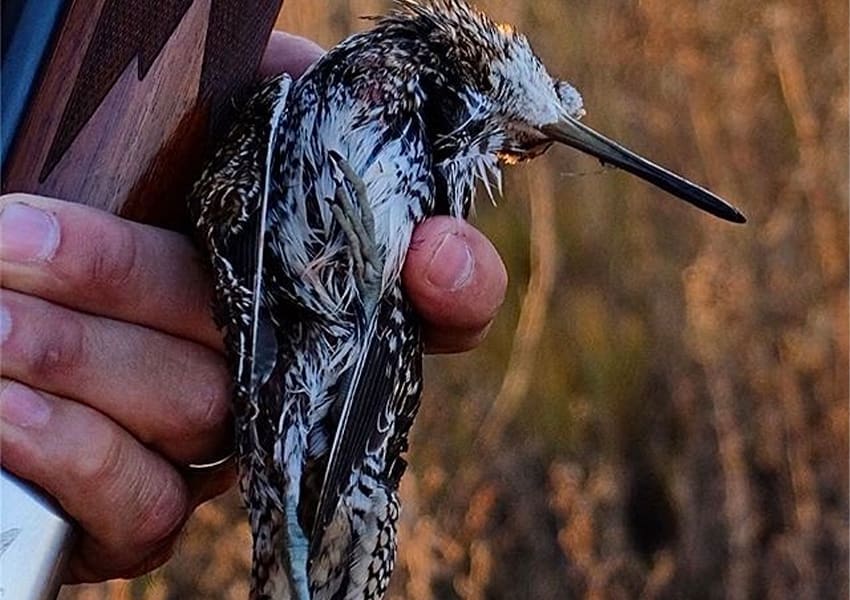
Macy bounded over through the water with vigor. Water splashed everywhere. With her nose close to the water, she began searching for scent. I could see bits of green mucky vegetation and what appeared to be tiny seeds all over her coat. The wiry-haired dog suddenly submerged her whole head into a clump of weeds and surfaced with something in her mouth. It was a snipe! I took the waterlogged, limp snipe and cradled it in my hand. I then thrusted the odd-looking bird into the air, like a trophy, for all to see. It was my first snipe.
I called Ryan over to let him take a look at the goofy-looking bird. Its camouflaged pattern made it nearly invisible. An intricate pattern of brown stripes and bars covered the little marsh bird. Its back had three long buffy streaks, one running down on both edges, and one down the center. The buff chest was streaked and spotted with brown near the top, and the rest of the bird’s underside consisted of a patch of white feathers.
Obviously, the most identifiable feature of the snipe was its long bill. Ryan tapped the bird’s brown bill with his finger. “They’re funny looking and so small and fast,” he said playfully. We passed the lifeless bird back and forth; we noticed a splash of orange at the base of its tail. Its color on the snipe’s rump teased of autumn. It was actually a gorgeous-looking bird.

The others had made their way over and they each took a turn holding the long-beaked bird. The group’s spirits had been lifted, and we had a new focus: Snipe. Within moments of re-engaging our hunt, we started to disturb waves of the birds. Small groups of snipe flushed, which caused a melee of shots to ring out. Strings of pellets filled the sky. Most of the shooting was futile. They zig-zagged, dipped, dived, and flew about, unscathed. A lesson quickly learned was that snipe really have no idea where they are going, and their last-second change in course mid-flight just causes rapid ammunition depletion. The snipe's eccentric flight pattern was puzzling and frustrating.
The barrage of gunfire probably sounded like a war zone to nearby duck hunters. Screams of “I got one! I got one!” gave a false sense of good shooting, as the next half-dozen shots reverted to misses. I added a few more birds to my bird vest after using up a good portion of my ammunition. While this was happening, I noticed that snipe would flush and make an overhead pass, circling around before landing again some distance away. Shouts of “Behind you! Above you! There goes one!” were heard constantly.
The dogs located most of the shot snipe. Some were found floating on the surface, and others were hidden in aquatic plants. Only two were lost. I had amassed an impressive count of four birds but had gone through an entire pocket of ammo–not a very good bird-to-shell ratio! A limit of eight snipe was going to require a lot more shotshells than I had. An additional problem we were experiencing was that we had started our hunt with shells made for killing larger-sized birds, such as roosters and ducks, definitely not tiny snipe. We needed loads made for doves and quail with a wide spread and a lot of pellets in the air.
Most gamebirds would have left the area, but not snipe. They were merely landing farther out into the marsh. I could see my best friend, focused on working the edges for snipe. He was smart to walk on the small patches of dry ground while the rest of us sloshed through small pools of open water and knee-high grass.
Ryan was about fifty yards away and engulfed in a flurry of shooting. He hadn’t shot a snipe, but I could tell by the smile on his face that he was having fun. I watched as two snipe flew over him. Like a howitzer, he raised the shotgun’s barrel into the sky and fired twice. He jumped out of the ankle-deep water, yelling, “I got one! I actually shot one!” He quickly found the bird and rushed over to me while holding it carefully in his hand.
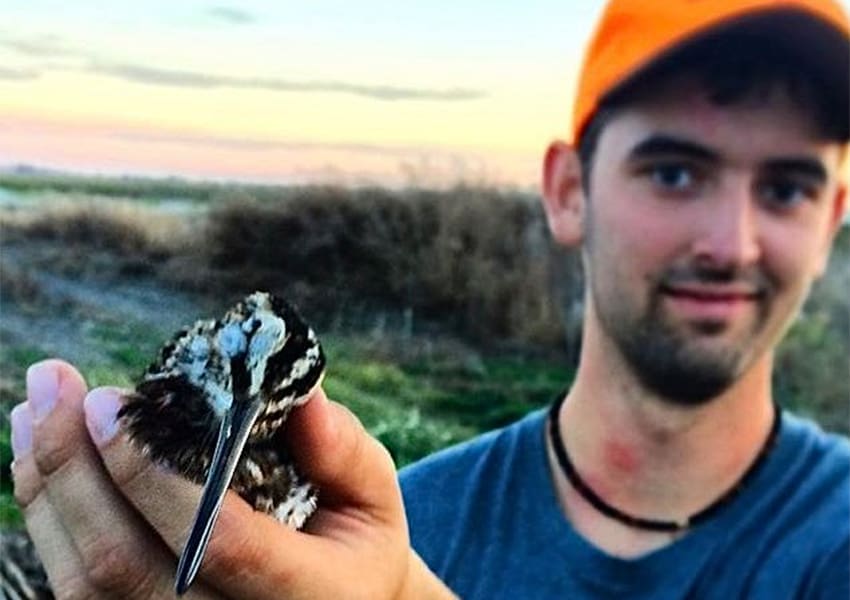
“My first bird. Wow. That was exciting. I went through a lot of shells, Edgar.” He caressed the snipe’s body, stroking its feathers. Time stood still during that moment. I watched him study the delicate bird over and over again. Everything else had been drowned out. His focus was on that first bird, the snipe. He would’ve stood there all day if it weren't for the barrage of gunfire and yelling.
The shots and shouts from the others quickly brought us back to reality. Everyone was either shooting or reloading. They were twisting and turning, trying to keep their balance so as not to fall into the water. The scene was chaotic but filled with smiles and laughter. Memories were being made. I had forgotten about sweating and the constant buzzing around me. The swarms of mosquitos hadn’t stopped filling their bellies with my blood, though it wasn’t as miserable as before. Ryan had returned to hunting and shooting snipe while I stood there, just watching. The little brown jets dive-bombed and banked in all directions, evading steel pellets from ground fire.
It’d been hours since we had discovered snipe. The sun was slowly setting. Daylight was dwindling, and so was our hunt. Snipe that took to the air had become dark silhouettes against the skyline. It was still humid as I stood there in the marsh. Boots couldn’t remain in place for too long, as the soft, boggy ground began to swallow us. Mosquitos continued to be swatted away.
Each splash of murky water disturbed more loafing snipe that took to the air from their hiding places. My ammo supply had dwindled to but a few shells, so each shot had to count. I bent down to pick up jettisoned shells from my over-under, as reloading had to be quick. I searched for the fifth snipe I had luckily shot. I had marked the bird well and walked straight to it, where I found it floating.
They were odd-looking birds. Certainly real, and not the imaginary creature of campfire stories and pranks. The legends and tall tales from our youth of the gooney birds that were hunted with sacks and flashlights were very much real. The snipe had taught us many lessons, especially in humility. The birds were difficult to read in the air. There was no rhythm in their erratic flight. We had come for roosters but ended up chasing snipe. Most would say there is no comparison between the two. One is long-billed, the other long-tailed. Both are splendid in their own right. But the snipe had presented us with something new and exciting.
The day ended with 14 snipe, shot between five hunters, displayed across the tailgate. Everyone had shot their first snipe that day. We laughed and retold our own stories of more misses than hits as the fiery sun slowly descended. Roosters could be heard crowing in the cattail fields. Outlines of flocks of speeding teal and other ducks flew overhead.None of these gamebirds mattered. The snipe had been elevated from an unknown, ignored, long-billed, foraging shorebird to a worthy adversary. As wet shotguns were wiped down, we made plans to drive into town to buy more ammo. Steel seven-and-a-half shells, instead of heavy pheasant and duck loads. Before leaving, someone yelled out, “We need to buy a few cans of bug spray, too!”